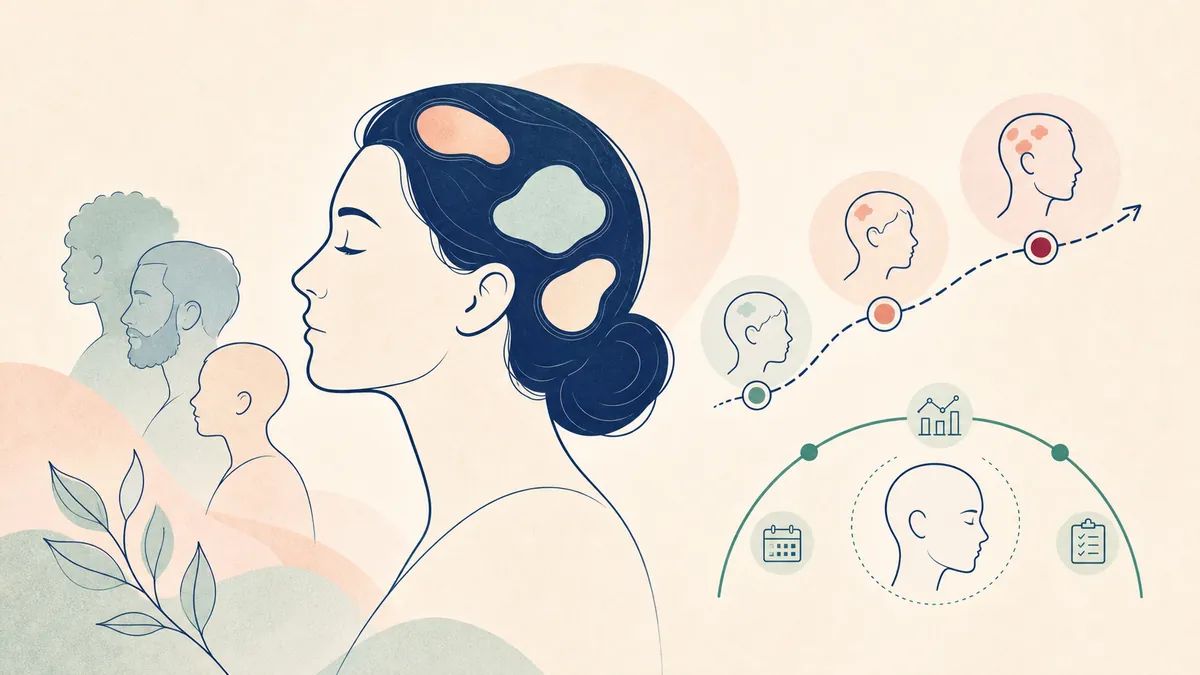
Key takeaways
- Pattern and timing guide the assessment. A slowly widening part, abrupt shedding, smooth patches, broken hairs and an inflamed scalp need different questions. AAD
- Topical minoxidil may help suitable pattern hair loss, with sustained use. HealthHub describes early shedding and growth after at least 3 to 6 months; benefit generally lasts only while treatment continues. HealthHub
- Oral minoxidil, spironolactone and finasteride are separate prescribing decisions. Some use in women is off-label; pregnancy, blood pressure, kidneys and other medicines affect suitability. BAD, AAD
Women’s hair loss: why pattern and cause change the treatment

A woman who has recently given birth may have obvious shedding and less noticeable hereditary thinning at the same time. The American Academy of Dermatology (AAD) uses this example in its diagnosis guide. Hair on the brush, a wider part and a sore scalp do not all point to the same cause. The assessment needs the dates of illness, medicines and pregnancy-related changes as well as an examination for scalp disorders. AAD
What does the pattern reveal?
Female-pattern loss usually produces a wider central part and gradual thinning over the top; the front hairline often stays intact. In the British Association of Dermatologists (BAD) leaflet, onset is usually in the 50s or 60s, occasionally the 30s or 40s. The scalp looks normal on examination. Affected hairs become finer, shorter and paler as follicles shrink, and the tendency may come from either parent or both. BAD
The AAD describes other causes that resemble this pattern. A photograph of a widening part cannot establish the diagnosis by itself.
Diffuse shedding may follow illness, surgery, childbirth, rapid weight change, nutritional deficiency, a new medicine or a major physiological stress. It can also uncover previously subtle pattern loss. The AAD shedding guide describes postpartum shedding becoming noticeable about 2 months after birth and peaking around 4 months. Fullness tends to return within 6 to 9 months as the body readjusts; ongoing stress can prolong excessive shedding. Smooth round patches suggest possibilities such as alopecia areata; scale, redness, pain, pustules or broken hairs raise other scalp and hair-shaft questions.
| Pattern or accompanying feature | Question to assess | Why self-treatment may miss the cause |
|---|---|---|
| Slowly widening part or reduced crown density | Female-pattern hair loss? | Other diffuse causes can coexist and may need testing |
| Sudden shedding across the scalp | Illness, pregnancy, medicine or another trigger? | Adding a growth product does not identify the trigger |
| Smooth discrete patches | Alopecia areata or another patchy-loss disorder? | Pattern-hair-loss products do not treat the immune process |
| Red, painful, scaly or scar-like scalp | Inflammation, infection or scarring loss? | Delay can risk permanent follicle damage in some conditions |
| Short broken hairs | Breakage, traction, active scalp disease or shedding from the root? | “Hair fall” descriptions often combine different processes |
Singapore HealthHub’s hair-loss overview adds nail changes, loss of eyebrows or eyelashes and unexplained hair-texture changes to the reasons for review. Sudden, severe or patchy loss, an inflamed scalp and hair loss related to illness or treatment also need assessment.
Where does topical minoxidil fit?
Topical minoxidil may support growth in suitable male or female pattern hair loss. It does not correct every cause of shedding. HealthHub’s medicine guide describes thickening hair strands and prolonging the growing phase. It puts visible growth at at least 3 to 6 months, with temporary shedding possible in the first 1 to 2 months. Benefit generally depends on continued use.
The AAD female-pattern guide gives 6 to 12 months of continuous use to judge how well minoxidil works. First visible growth and judging the overall response are different points in the treatment course. AAD
Form matters here too. HealthHub specifies clean, dry hair and scalp for lotion, while foam may be applied to damp hair. Its guide warns against using a hair dryer after application and says to let the medicine dry before bed or other hair products; otherwise it can stain clothing or bed linen. The product’s own instructions still apply. HealthHub
Irritation can include dryness, scaling, itch or redness. Unwanted facial hair can result from drips onto the forehead or face, which HealthHub advises avoiding. Dizziness, rapid heartbeat or swelling need product-specific advice. More product does not speed growth. An inflamed, infected or sunburned scalp can increase problems.
Pregnancy, planning pregnancy and breastfeeding change the decision. Check the current instructions and a healthcare professional’s advice before starting or continuing from an online routine. HealthHub also asks about allergy to other ingredients, such as propylene glycol or ethanol. HealthHub
Why are oral options a separate discussion?
Oral medicines have different effects and precautions from scalp treatment. Some dermatologists use low-dose oral minoxidil, spironolactone or finasteride for selected women. These are not equivalent to topical minoxidil and are not interchangeable with one another. The reason for choosing one, and whether its use for hair loss is licensed locally, must be made explicit.
Oral minoxidil can affect blood pressure, pulse and fluid retention. Spironolactone affects potassium and kidney handling and has pregnancy implications. Finasteride has important pregnancy precautions and is not a general treatment for unexplained shedding. The AAD describes these as clinician-selected prescription options rather than universal first choices.
BAD describes oral minoxidil’s earlier use for high blood pressure: increased facial hair during treatment helped prompt development of the topical product. BAD
Do not borrow tablets or split someone else’s hair-loss medicine. An off-label prescription needs an individual assessment of the indication and evidence. The term alone does not establish safety or benefit for a particular woman.
What should be checked before blaming one cause?
The examination and history guide testing. BAD identifies irregular periods, increased facial hair, acne and infertility as possible signs of polycystic ovary syndrome (PCOS), which can accompany female-pattern hair loss. Menstrual changes therefore belong in the consultation alongside pregnancy and postpartum timing, weight, diet, illness or surgery, family pattern, styling, scalp symptoms, medicines and supplements. BAD
A dermatologist may gently pull some hairs to check how they grow and break. The AAD also describes examining nails and other affected areas, with blood tests or a scalp biopsy when the findings suggest deficiency, hormonal imbalance, infection or disease. Its examples of treatments for other causes include antifungal medicine for scalp ringworm and, for painful inflammation in frontal fibrosing alopecia, clinician-selected antibiotics or antimalarials. These are diagnoses requiring their own treatment decisions. AAD
Record when each medicine was started, changed or stopped. The AAD shedding guide includes coming off birth-control pills among shedding triggers. Check with the prescriber before abruptly stopping a suspected medicine; the illness being treated may itself explain the loss.
Iron, thyroid or other tests should follow the clinical picture. HealthHub says biotin and similar supplements have no proven hair-growth role without deficiency. The AAD gives iron poisoning, with early stomach pain and vomiting, as an example of harm from excess supplementation. AAD
Excess supplements can also interfere with laboratory tests.
What changes the answer?
The pattern, scalp condition, pregnancy plans, other illnesses and treatment history all affect the choice.
- The pattern and speed. Gradual patterned thinning and abrupt shedding need different work-ups.
- Scalp inflammation or scarring. Pain, scale, pustules and shiny areas can require earlier dermatology assessment.
- Pregnancy and contraception. Several topical and oral options require avoidance or a specific prevention discussion.
- Blood pressure, heart and kidney history. These matter particularly when an oral medicine is considered.
- Other medicines. Antihypertensives, diuretics and medicines associated with shedding can alter both diagnosis and safety.
- Treatment horizon. Hair growth is slow; an early photograph and consistent parting can be more informative than day-to-day shed counts.
When should hair loss be assessed promptly?
Sudden or rapidly progressive loss, patches and scalp symptoms need assessment. Arrange review for smooth patches, eyebrow or eyelash loss, scalp pain, marked redness, scale, crusting or pustules, shiny scar-like areas, or hair loss with systemic symptoms. A widening part that continues despite an appropriate trial also needs review. BAD also asks people to raise the emotional impact: hair loss can affect self-esteem and body image, and this deserves support during treatment. BAD
Bring photographs showing the time course and all medicines, supplements and hair products. The hair-loss category, androgenetic alopecia condition page and alopecia areata page can help label the questions, but they cannot replace examination of the scalp.
Sources
- Singapore HealthHub: Hair Loss.
- Singapore HealthHub: Topical Minoxidil.
- British Association of Dermatologists: Female pattern hair loss.
- American Academy of Dermatology: Could it be female pattern hair loss?.
- American Academy of Dermatology: Hair loss: diagnosis and treatment.