Key takeaways
- Singapore has 3 supply classes: GSL through general retailers, Pharmacy-Only through a pharmacist, and POM from a doctor or a pharmacist with a valid prescription. HSA
- The class applies to a particular product and its supply conditions. It does not rank quality, strength or effectiveness. HSA
- Online POM and Pharmacy-Only supply is restricted to licensed healthcare institutions or pharmacies, and the medicines must be HSA-registered. MOH
OTC, Pharmacy-Only and Prescription-Only medicines in Singapore
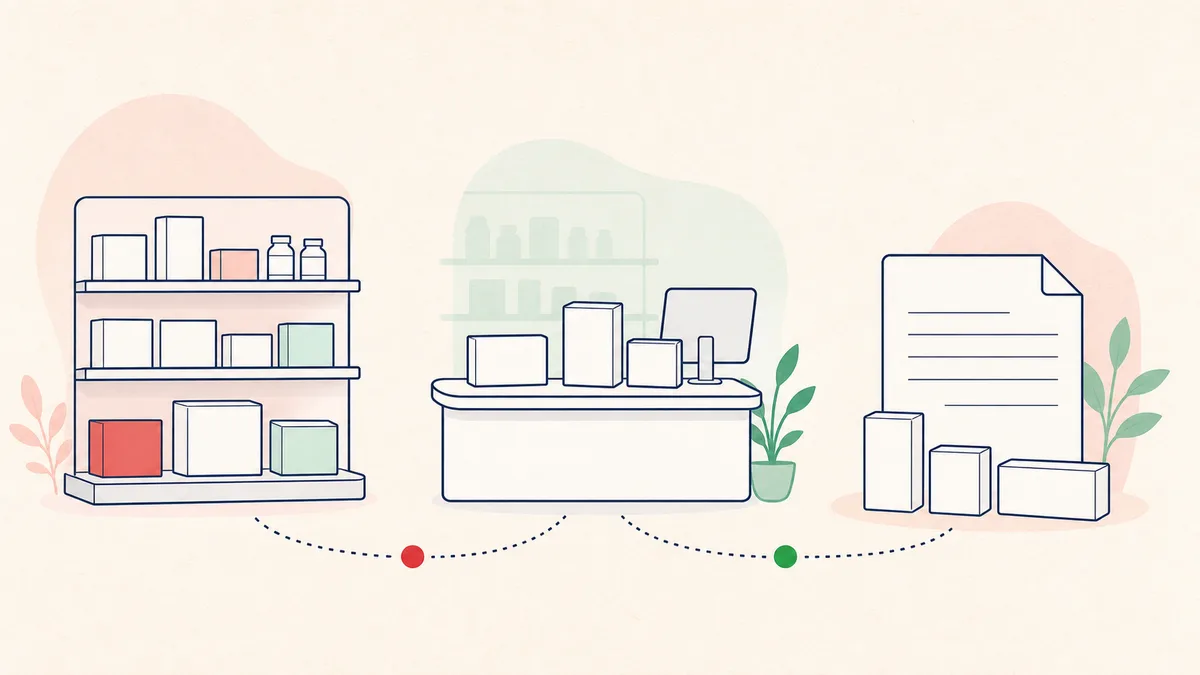
HSA calls these “forensic classifications”: General Sale List (GSL), Pharmacy-Only (P) and Prescription-Only Medicine (POM). They describe access controls. They do not decide whether a particular person should take the medicine, and a catalogue listing does not make it suitable for self-selection.
For Pharmacy-Only supply, HSA says pharmacists must keep a dispensing record. Its public guidance asks for your name, NRIC or FIN, and contact details such as an address, telephone number or email. Pharmacist involvement includes those records as well as advice about the medicine.
What do the three classes mean?
They determine the route of supply and the professional involvement required. HSA describes GSL products as intended for common, self-limiting ailments that people can generally recognise and manage without medical supervision. They are commonly supplied in small packs suited to short-term self-treatment and can be obtained from general retailers.
Pharmacy-Only medicines do not require a prescription, but must be supplied by a pharmacist at a retail pharmacy. HSA describes short-term use for minor conditions, with advice on proper use, treatment duration, precautions and interactions. The pharmacist may ask who will take it, the symptoms and their duration, what has been tried, and what other conditions or medicines could affect suitability.
POM medicines can be obtained from a doctor, or from a pharmacist with a valid prescription. Diagnosis, monitoring, administration or instructions from a doctor may be needed. Many medicines in antibiotics, erectile dysfunction and long-term disease management fall within this class.
| Singapore class | What the supply route means | What the class does not prove |
|---|---|---|
| GSL | May be supplied by general retailers | That it suits every age, symptom, pregnancy or medicine combination |
| Pharmacy-Only | Supplied by a pharmacist without a prescription | That it can be taken without questions, records or a duration limit |
| Prescription-Only | Requires a valid prescription | That any product with the same ingredient is interchangeable |
“OTC” can obscure the distinction. HealthHub uses OTC alongside GSL, then describes Pharmacy-Only as a separate class requiring a pharmacist consultation and personal identification. Both may be described in everyday conversation as non-prescription medicines. Check whether the particular product is GSL or P when that difference matters.
Why can the same ingredient appear under different controls?
Classification concerns the product and approved supply conditions, not the ingredient alone. Strength, dosage form, route, pack size, indication, age group and warnings can affect those conditions. A small pack for a short-lived symptom may differ from another strength, form or use of the same ingredient.
There are changes in both directions in HSA’s reclassification list. A listed pilocarpine eye-drop product changed from P to POM on 21 April 2026. A listed loratadine tablet changed from P to GSL on 8 September 2025. Each entry names a particular product. To check another product, HSA points to Infosearch for its current registration and class.
Check the whole label of a cold-and-flu combination. It may duplicate an ingredient in another medicine you take, and the individual ingredients can have different contraindications. Compare the fields explained in the medicine-label guide, rather than relying on a familiar word in the brand name.
Does a class tell you how safe or effective a medicine is?
It describes supply control, without ranking clinical value. POM does not mean better or stronger; GSL does not mean harmless. Common medicines can cause allergy, interact with anticoagulants, affect kidney or liver disease, or duplicate an ingredient in another product.
HealthHub’s self-medication guide advises telling the doctor about self-medication even when the appointment concerns a different illness. It recommends keeping a medicine list because combinations can reduce effectiveness or increase adverse effects. It also recommends professional advice for infants, children and older people, who may be more sensitive to medicines or need different instructions.
What happens when a medicine is shown online?
The medicine’s supply controls still apply. In its parliamentary answer of 12 November 2024, MOH says only licensed healthcare institutions or licensed pharmacies may supply POM and Pharmacy-Only medicines online. Those medicines must also be registered with HSA. Licensing conditions include secure transmission of electronic prescriptions and appropriate storage; compliance and quality checks apply to marketed medicines.
The same MOH answer says HSA monitors local websites and e-commerce platforms to detect and disrupt illegal medicine sales. Its advisories warn about overseas or unknown sources because products may be unregistered, substandard or counterfeit. A price, thumbnail or “add” button tells you none of that, and cannot establish suitability for the person taking it.
Keep the ingredient, complete strength, dosage form and route from the packet beside the online listing. Is it the same product? What class and registration status apply now? Those details may be checked in product records. Whether it suits your symptoms, conditions and other medicines is a separate question for a pharmacist or doctor when needed.
What changes the answer?
The product details and the person’s circumstances both matter. Check ingredient, strength, form, pack size and approved use. Age limits, pregnancy and breastfeeding may affect an otherwise generally available medicine. Kidney, liver or heart disease, ulcers, allergies and interacting medicines can make self-treatment unsuitable.
Persistent, severe, recurrent or unclear symptoms may need referral. HealthHub advises stopping self-medication and consulting a doctor if symptoms persist after 1 to 2 weeks or worsen. Its urgent-warning list includes blue or purple lips, chest pain, changed consciousness and difficulty speaking; those need immediate attention rather than waiting for that interval. Long-term asthma, diabetes, high cholesterol and high blood pressure need regular clinical follow-up.
Registration and classification can change. Old packaging, forum advice and a product’s status in Malaysia, the UK, Australia or another country do not establish its Singapore status. Use HSA Infosearch or ask a pharmacist, with the full ingredient, strength, form and route available for comparison. Keep GSL, P and POM as supply descriptions, rather than quality labels.
Sources
- HSA Singapore: List of reclassified medicines and definitions of POM, P and GSL.
- Ministry of Health Singapore: Regulation measures for sale of medication or prescription drugs through online retailers.
- HealthHub Singapore: Principles of self-medication.
- Reddit r/singapore: Question thread about OTC medicine access Used only as a reader-question signal.