Key takeaways
- Generic names identify active substances across brands. WHO selects internationally recognised names that are public property. WHO
- An approved generic must meet regulatory requirements. The FDA assesses the ingredient, strength, dosage form, route, quality and bioequivalence against a reference medicine. FDA
- A matching ingredient alone cannot establish interchangeability. Check the full product, including formulation, device, directions and health context; EMA distinguishes hybrid products with different strengths, routes or indications. EMA
Brand Name, Generic Name and Active Ingredient: What Is the Difference?
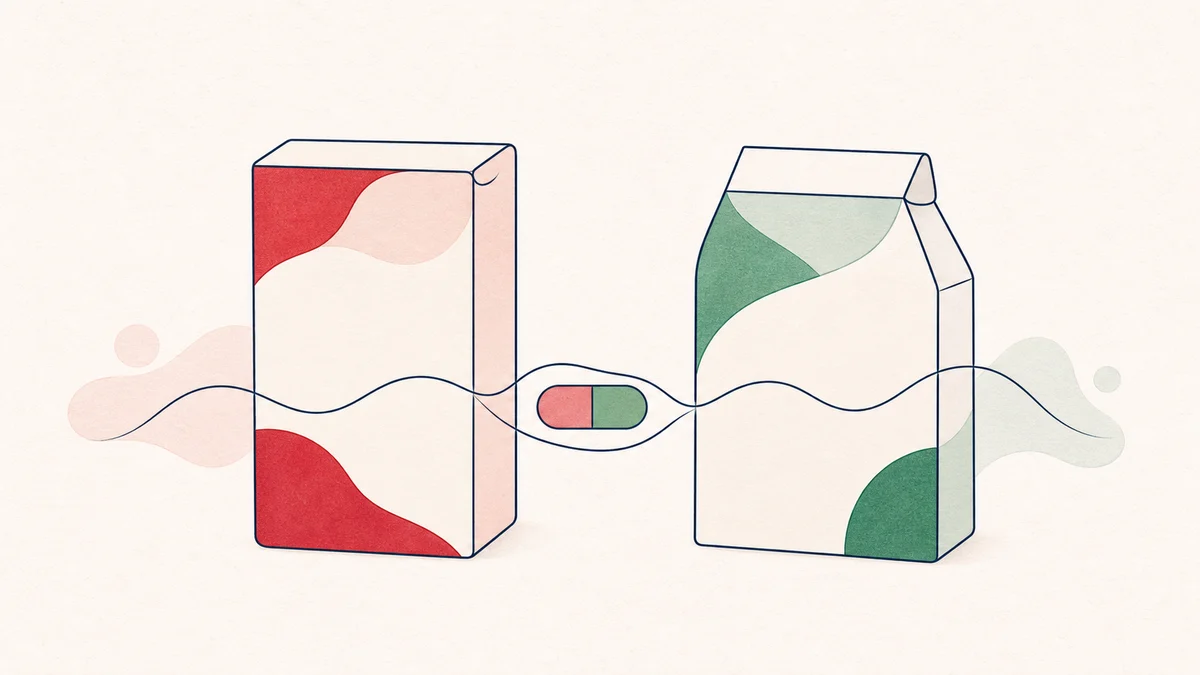
WHO works with national naming committees to choose an International Nonproprietary Name (INN) for each active pharmaceutical substance. These names are public property. They appear in pharmacopoeias, product information, regulation and scientific papers as well as on medicine packs. Brand names identify particular companies’ products; the generic name identifies the substance intended to produce the pharmacological effect. WHO
What does each medicine name tell you?
The brand identifies a marketed product; the generic name usually identifies its active pharmaceutical substance.
| Label term | What it identifies | What it does not prove |
|---|---|---|
| Brand or product name | A marketed product from a particular company | Which ingredient, strength or formulation is inside unless you read further |
| Generic or non-proprietary name | Usually the active pharmaceutical substance | That every product carrying it has the same strength, release pattern or route |
| Active ingredient | The component intended to produce the pharmacological action | That inactive ingredients, device design and product instructions are identical |
The World Health Organization assigns International Nonproprietary Names (INNs) so that active pharmaceutical substances have distinctive names that can be recognised internationally. For example, Panadol is a brand, while paracetamol is the active ingredient. Ventolin is a brand, while salbutamol is the ingredient name used in Singapore and many other countries.
WHO asks that trademarks neither derive from INNs nor contain their shared stems, to reduce confusion that could harm patients. When a brand is unfamiliar, look for the ingredient line on the pack. WHO
Does “generic medicine” mean unbranded medicine?
A generic medicine can have a brand or company name. In the US, its manufacturer submits an abbreviated new drug application (ANDA). The FDA requires pharmaceutical equivalence, bioequivalence and evidence that the manufacturer can consistently make the product correctly. The reference medicine is already authorised. FDA
Regulatory definitions differ in detail by jurisdiction, but they share important principles. The US Food and Drug Administration says an approved generic must match its reference medicine in active ingredient, strength, dosage form and route, and demonstrate bioequivalence. The European Medicines Agency similarly explains that a generic has the same active substance and produces the same levels of it in the body as the reference medicine; its name, appearance, packaging and inactive ingredients may differ.
The FDA generic application uses the reference medicine’s established safety and efficacy evidence. Bioequivalence tests concern active-ingredient delivery at a comparable rate and extent under the tested conditions, not tablet colour or taste. Generic availability also depends on regulatory protection. In the EU, EMA says marketing normally starts 10 or 11 years after the reference product’s first authorisation, once marketing protection has expired. Filing an application first requires expiry of data exclusivity. FDA, EMA
FDA laboratory surveillance continues after approval. Risk-based sampling can investigate a suspected impurity or contaminant by testing identity, potency, dissolution or purity. Printing the ingredient on an online listing supplies no evidence that a product has this approval. FDA
Why can one ingredient have many brand names?
Different manufacturers can market authorised products containing the same active substance under different names. A single pharmacy shelf may therefore contain several boxes whose largest words are different but whose active-ingredient lines match.
Two errors to avoid:
- Treating different brands as different medicines. A person may unintentionally use two products containing the same ingredient because the front-of-pack names do not match. This is especially easy with multi-symptom products.
- Treating every matching ingredient as the same product. One product may be a standard tablet and another modified-release; one may be swallowed and another applied to the skin; one may contain a single ingredient and another a combination.
Why do generic names sometimes look or sound related?
Shared stems in WHO names indicate a relationship between substances. WHO publishes proposed suffixes as pre-stems before expert adoption so possible problems can be raised; its programme page lists a February 2026 pre-stem publication. Naming conventions undergo review too. WHO
Atorvastatin and other names ending in “-statin” resemble each other, but identify distinct substances. Their strengths, interactions and instructions differ; the ending does not establish substitutability.
WHO works with naming committees including those responsible for BAN (British Approved Names), USAN (United States Adopted Names), French DCF and Japanese JAN. Most national names now match the international name, with rare exceptions. WHO
On US labels, acetaminophen means paracetamol and albuterol means salbutamol. Each pair names one substance. Check an unfamiliar spelling in an official label or medicines database before treating it as an equivalent name.
How should you compare two medicine packs?
Compare ingredients, strength, form, route, directions and registration.
- Active ingredient or ingredients: check every component, especially in combination products.
- Strength: compare the quantity per tablet, capsule, measured volume, actuation or other unit, not just the number printed most prominently.
- Dosage form and release wording: tablet, capsule, liquid, cream, inhaler and patch are not interchangeable descriptions. Terms such as MR, SR, CR, ER, XR or “modified release” require attention.
- Route: confirm whether the product is intended to be swallowed, inhaled, applied to skin, used in the eye or given another way.
- Directions and warnings: these are part of the product information, not decoration around the ingredient name.
- Registration and product details: Singapore’s HSA therapeutic-product search displays registered products with their dosage form, route, active ingredient and strength. Malaysia’s NPRA directs consumers to its QUEST3+ search for product status.
EMA describes a hybrid medicine as one relying partly on the reference medicine’s test results and partly on new clinical-trial data. A changed strength, route or slightly different indication can require this route. EMA
What changes the answer?
Modified-release or enteric-coated products, devices, salts, esters and changed routes need closer comparison. A cream and a tablet can contain a similarly named ingredient yet place it in very different parts of the body. An inhaler’s device technique can matter alongside the ingredient. A combination product adds another layer because every active ingredient must be matched.
Inactive ingredients can change colour, shape, taste, texture or tolerability. Regulators permit some differences; a known allergy or sensitivity makes the complete ingredient list relevant.
In the FDA’s 26 February 2024 interview on narrow-therapeutic-index medicines, pharmacologist Mehul Mehta names warfarin and levothyroxine as examples. Small changes in dose or blood concentration can cause treatment failure or serious adverse effects. His colleague Liang Zhao describes tighter US quality and bioequivalence criteria for their generics. Monitoring remains necessary; the FDA still regards approved generic versions as clinically substitutable for their brand-name counterparts. FDA
Age, pregnancy, kidney or liver function, the condition being treated and other medicines can change whether a product is suitable. Those questions cannot be answered by decoding the name.
What should you do when the name changes unexpectedly?
Keep the packaging and ask the dispensing pharmacist to verify an unexpected change before use. Do not identify it by appearance alone, or stop, change or double it because of uncertainty. Compare the ingredient, strength, form and directions with the previous supply, including any change of tablet or manufacturer.
A different colour, shape, texture or manufacturer is a familiar concern in patient forums. Appearance alone does not demonstrate a clinical difference. In its 18 September 2026 Q&A, the FDA acknowledges that inactive ingredients can occasionally affect tolerability or absorption; reported problems deserve clinical attention. It also explains that a suspected equivalence problem can lead to a changed Orange Book therapeutic-equivalence code, even when no safety signal has been identified. This is a US regulatory process for examining a problem, rather than something a patient can judge from tablet colour. FDA
For catalogue research, an ingredient page such as metformin groups products whose strength and dosage form can then be compared. Keep the packet leaflet too. Even a tablet that looks unchanged can be past its expiry; the FDA warns that chemical changes may affect safety or effectiveness after that date. A pharmacist or doctor who knows the prescription and patient should resolve suitability and substitution questions. FDA
Sources
- WHO: International Nonproprietary Names Programme.
- FDA: Generic Drugs: Questions & Answers.
- European Medicines Agency: Generic and hybrid medicines.
- HSA Singapore: PRISM therapeutic products search.
- FDA: Setting and Implementing Standards for Narrow Therapeutic Index Drugs.